
You get handed a list. No gluten. No dairy. No eggs. No nightshades. No grains.
Somewhere around item six, you stop reading what you can eat and start doing the math on what is left.
That happened to me too. I tried the full elimination list, got so overwhelmed by what I could not eat, that I nearly stopped eating altogether.
Then I heard of the modified AIP diet.
Prefer to Listen?
Subscribe:


Health with Hashimoto’s is your free weekly podcast that sorts this autoimmune condition into thyroid or immune. Each episode is for informational and educational purposes. Please discuss any questions or concerns with your trusted healthcare professional. Some links may be affiliate links, marked as such, at no extra cost to you.
The AIP diet is one of the most common diet recommendations you will run into with Hashimoto’s. If you want the bigger picture on sorting through all the diet advice out there, I cover that in Navigating the Diet Maze: What to Eat with Hashimoto’s. Today’s post covers podcast episodes 113 (AIP) and 200 (the modified AIP diet with author Mickey Trescott.)
What the AIP diet actually does for Hashimoto’s
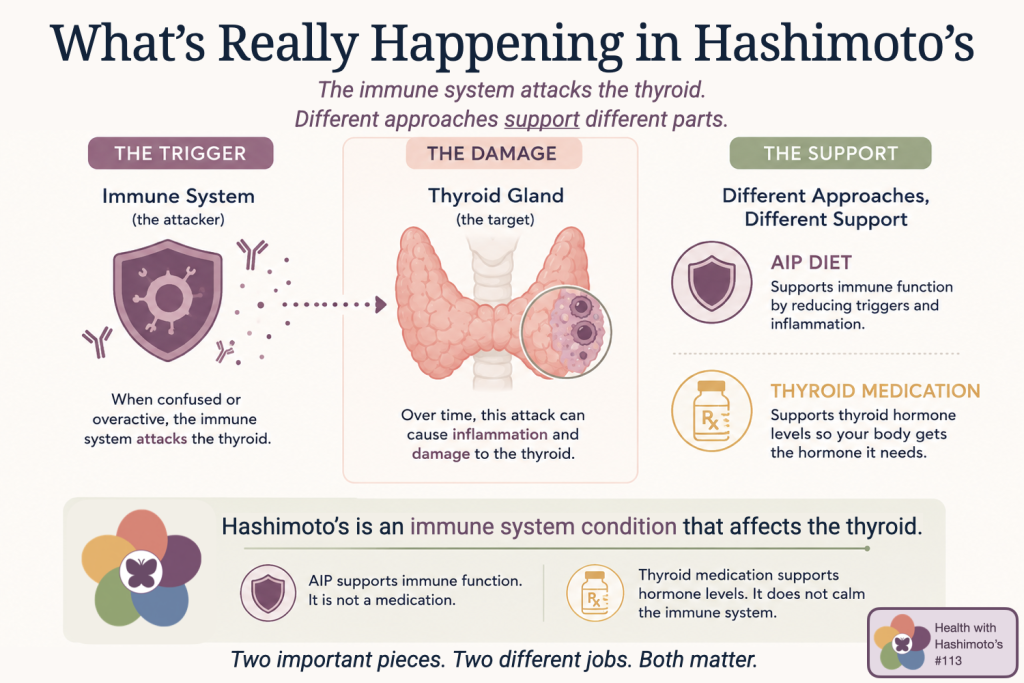
Hashimoto’s is not just a thyroid problem. It is an immune system problem that happens to attack your thyroid.
Your medication (Synthroid, levothyroxine, Armour) supplements the hormone your thyroid can no longer make enough of. It does nothing for the immune system that is attacking your thyroid in the first place.
That is where gut health comes in. About 70 to 80 percent of your immune system lives in your gut. If your gut is not working right, your immune system is not working right either. I go deeper on this in How to Improve Gut Health with Hashimoto’s Without Overwhelm.
If you laid your entire gut lining flat, stomach to the end, it would cover a space the size of a tennis court. Almost all of that surface is only one cell thick.
That thin lining is by design. It lets nutrients pass through into your body. It was never meant to let whole, undigested food particles through.
When it does (often called a “leaky gut”), your immune system treats that food particle like an invader. It attacks. The next time you eat that food, your body remembers and attacks again. That is how food sensitivities develop.
The AIP diet was built to address three things at once: support your gut lining, identify food sensitivities, and lower overall inflammation. All three feed into calming an immune system that is currently confused about what to attack.
What the original AIP diet eliminates
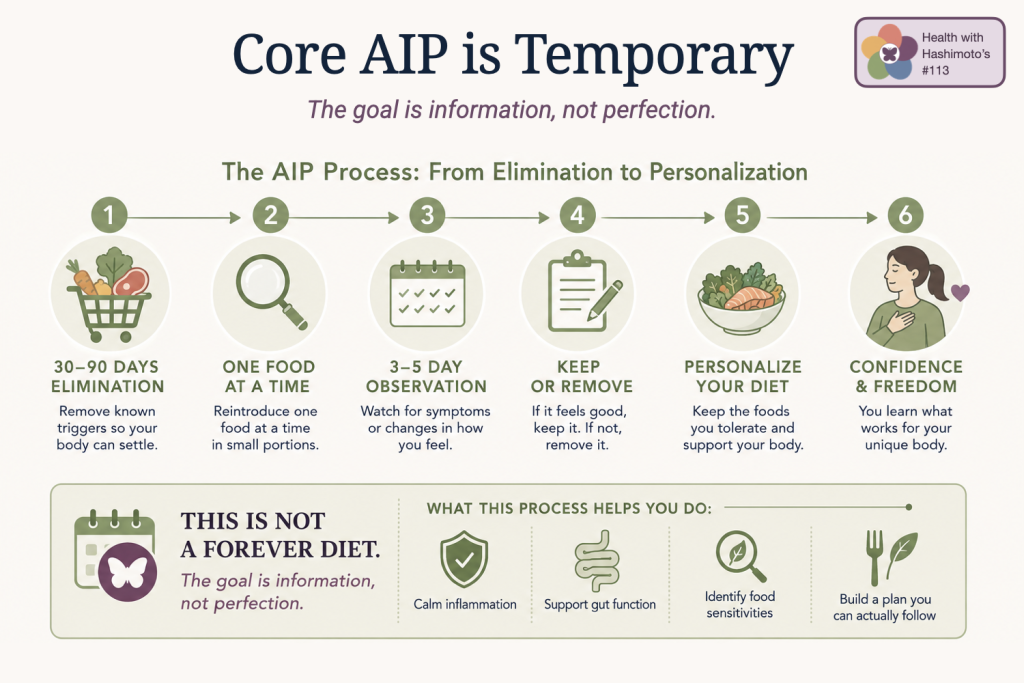
The original version (what Mickey Trescott now calls “core AIP”) is an elimination diet. You remove a long list of foods for a defined period, usually 30 to 90 days, then reintroduce them one at a time.
Here is what gets eliminated:
- All grains, not just gluten (wheat, barley, rice, every grain)
- Legumes, including beans, nuts, seeds, and nut or seed butters
- Eggs
- All dairy, including cheese
- Nightshades (potatoes, tomatoes, peppers, and pepper based spices like paprika and chili powder)
- Seed oils (canola, rapeseed, soybean, sunflower)
- Refined sugars (cane sugar, corn syrup, brown rice syrup, barley malt syrup, and processed sweets made with them)
- NSAIDs, tobacco, alcohol, and coffee
That is a lot to give up at once. I know because I have done it.
This is not a forever diet. No elimination diet should be. Thirty days is the shortest window worth trying. Ninety gives your gut more time to settle.
Why a modified AIP version exists now
I interviewed Mickey Trescott for episode 200. She has a master’s degree in functional nutrition, and she was diagnosed with Hashimoto’s and celiac disease about 15 years ago after a health crisis that left her bedridden.
Before that, she was rock climbing, cycling, and running. She could not explain why her body suddenly stopped working, and doctor after doctor told her nothing was wrong.
Mickey was one of a small group of women who tried removing grains, legumes, eggs, nuts, seeds, and nightshades based on early research into leaky gut and autoimmune disease. At the time, the entire protocol was one sentence in a few functional medicine circles. There was no reintroduction plan. No structure. Just a list of foods to remove.
That original list is what we now call core AIP.
Mickey told me it took her about nine months to see real improvement. She also needed the right medical care alongside it, and she did not find a doctor willing to properly treat her Hashimoto’s until her sixth specialist.
Fifteen years later, she has written a new book called The New Autoimmune Protocol. In it, she lays out a second option: modified AIP. It keeps the parts of the protocol shown to help the most, while including some foods the original version removed, based on more recent research.
Mickey built modified AIP because core AIP works, but it is also genuinely hard. She told me plenty of people try it, find it too stressful to stick with, and quit before getting any benefit at all.
What the research actually shows
Mickey and a small group of women tried it anyway, sharing their experiences in a Facebook group, basically a girlfriend group chat before that was a common thing to have online. Out of that collective experience, a movement was born.
Fast forward 15 years, and AIP now has actual human studies behind it. Two studies specific to Hashimoto’s showed meaningful symptom improvement in 10 and 12 weeks. A study in IBD showed 73 percent of participants reached clinical remission in just 6 weeks. Research in psoriasis and rheumatoid arthritis has followed. Across all of this research, roughly 3 out of 4 people experience meaningful improvement when they follow the protocol.
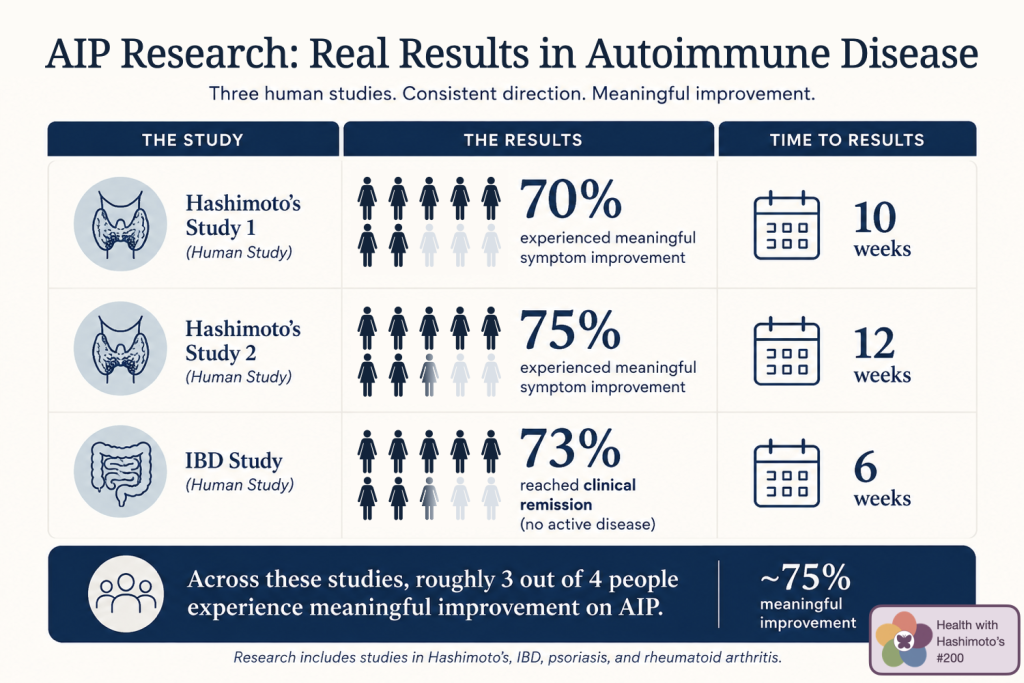
Mickey was also careful to point out what this research does not claim. Hashimoto’s does not have a clean marker like remission the way IBD does, since improvement gets measured through reported symptoms rather than a scope. Even so, the direction of the data is consistent. Fewer symptoms, and in one study, measurable changes in thyroid swelling on ultrasound.
How the reintroduction phase works
The elimination phase is only step one. Step two is reintroduction, and this is where a lot of people get stuck, because it takes patience.
Here is the process:
- Pick one food to reintroduce (say, tomatoes)
- Eat a small amount, two times, on day one
- Track how you feel for the next three to five days (some reactions take up to 72 hours to show up)
- If nothing happens, you can bring that food back into your diet
- Wait five to seven days before reintroducing the next food
That timeline matters. Reintroducing every grain, then every legume, then every nightshade, one at a time, is going to take a while. It is not a step you can rush without losing the information you are trying to gather.
If you skip reintroduction and just stay eliminated forever, you never actually find out what your body can tolerate. You are just guessing, indefinitely.
What to do when you flare (without starting over)
What happens when you flare after you have already reintroduced foods? Do you start the whole elimination phase over again?
Mickey calls it “battening down the hatches,” and the answer is no.
When she notices early signs of a flare (not recovering from workouts, struggling to get out of bed), she pulls back to her foundational foods. She cuts out her personal gray area foods, the ones that do not always cause a clear reaction but tend to cause problems if she eats them a few days in a row.
For her, eggs are a gray area food. Rice is not, she has never reacted to it and keeps it in her diet even during a flare.
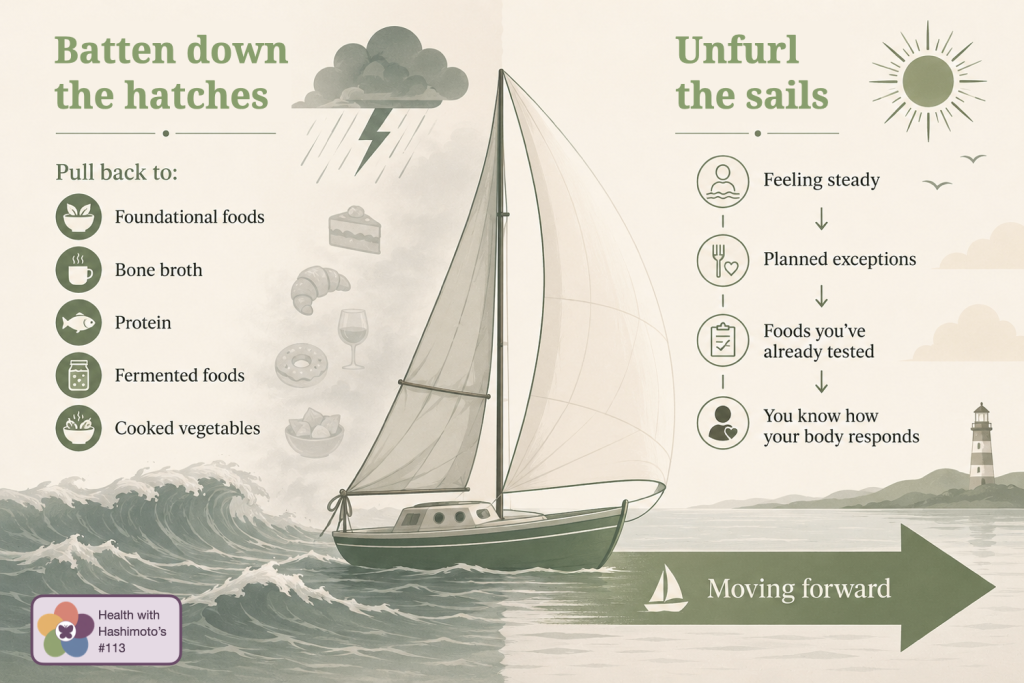
During a flare, Mickey leans on foods she already knows are safe. Bone broth. Protein. Fermented foods. Colorful vegetables, usually cooked rather than raw.
Once she feels steady again, she “unfurls the sails,” meaning she allows herself planned exceptions with foods she knows might cause a mild reaction, because she has already done the work of knowing what those consequences look like.
How to decide which version is right for you
There is no single right answer between core AIP diet and modified AIP diet. It depends on your body, your capacity right now, and what you are trying to learn.
Mickey recommends something before you start either version: a confidence assessment. Rate yourself, one to ten, on the areas that tend to derail a diet change. Cooking skill. Budget. Time. Support at home.
Whatever comes back low is your actual barrier, and it is worth solving before you start, not while you are also trying to eliminate six food groups at once.
That is really what this whole post comes down to. Core AIP and modified AIP are not competing diets. They are two tools, and the work is figuring out which one fits your body and your life right now.
Frequently Asked Questions About AIP for Hashimoto’s
Where this leaves you
You now know the difference between core AIP and modified AIP, what the research actually shows, and how reintroduction works.
But knowing the list of foods was never really the hard part. The hard part is figuring out which version applies to your body, which foods are actually your gray area foods, and how to build a plan around your life instead of a generic list.
That is exactly the work I do inside Hashimoto’s Discernment Coaching. Not more information. A way to think about all of it, specific to you.